
History
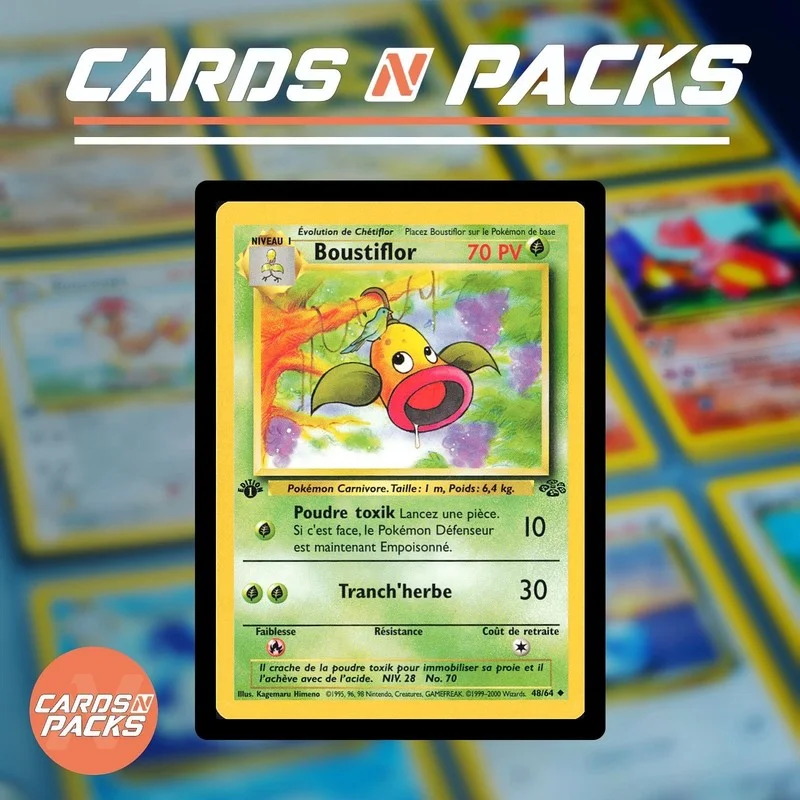
Bellsprout, the Flower Pokémon of Grass/Poison type, is #69 in the National Pokédex and the evolution of Oddish. Known for its thin, flexible body and bell-shaped head, Bellsprout uses its roots to anchor itself to the ground or absorb nutrients. Its depiction on card 48/64 from the Jungle expansion perfectly captures its essence.
The Jungle expansion, released in 1999, is the second major expansion of the Pokémon Trading Card Game in the West, following the historic Base Set. It introduced 48 new Pokémon to the TCG, significantly broadening the pool of available cards and adding new strategies. Bellsprout's presence in this expansion illustrates Nintendo's desire to diversify the Pokémon available from the very first waves of cards.
The artwork for this card is the work of the talented Yuka Morii, renowned for her unique artistic style using clay figures or real objects to represent Pokémon. Her approach gives the creatures a particular texture and depth, making them stand out distinctly. On this card, Bellsprout is depicted in a natural environment, highlighting its simplicity and connection to flora.
Fun facts
- Bellsprout is a Grass/Poison type Pokémon, a combination that grants it unique resistances against certain types and vulnerabilities to others, making it a strategic Pokémon from the very first generations.
- Artist Yuka Morii is renowned for her use of photography of clay models or real objects for her illustrations, giving Pokémon a tangible, textured appearance, as seen on this Bellsprout card.
- The Jungle expansion was the first to introduce different rarity symbols for cards (circle for common, diamond for uncommon, star for rare), which was a novelty compared to the Base Set.
Collector's tip
For collectors, the Bellsprout 48/64 card from the Jungle expansion in 1st Edition is a piece of TCG history. The "1st Edition" stamp is essential and must be clearly visible to attest to its authenticity and increased value compared to the unlimited edition. As a common card, its value largely depends on its condition. Carefully check the edges, corners, surface, and centering. A card in excellent condition, protected in a sleeve and top-loader, will always be more sought after to complete a vintage collection.


