The link between competitive play and the card market
The Pokemon TCG (Trading Card Game) is far more than a collectible card game: it is a global competitive ecosystem that generates hundreds of tournaments each year, thousands of professional and semi-professional players, and a secondary market whose prices react in real time to competitive results. For savvy collectors and investors, understanding competitive play has become an essential strategic lever to anticipate Pokemon card price movements.
The mechanism is simple but powerful: when a deck wins a major tournament -- a Regional, an International, or the World Championships -- the cards it contains see their demand explode instantly. Players worldwide want to replicate the winning list, speculators buy up available stock, and prices surge within hours. Conversely, when a card is banned, when a rotation makes a deck obsolete, or when a new set introduces a better replacement, prices can drop just as quickly.
This phenomenon creates a fascinating dual market: competitive value (tournament utility) and collectible value (rarity, artwork, nostalgia) coexist, sometimes reinforce each other, and often diverge. A card can be worth $40 for its gameplay utility and only $2 as a collectible -- or the reverse. Understanding this duality is essential for anyone looking to navigate the Pokemon card investment market intelligently.
How the Pokemon competitive circuit works
The Pokemon TCG competitive circuit is organized by The Pokemon Company International (TPCi) and follows a rigorous pyramid structure. Each season (September through August), players accumulate Championship Points (CP) across different tournament tiers to try to qualify for the World Championships.
League Cups and League Challenges
This is the base of the pyramid. These local tournaments are organized by authorized game stores (Pokemon Leagues) worldwide. They attract between 8 and 64 players and distribute modest Championship Points. Their impact on card prices is negligible, but they allow players to test the decks that will later make waves at higher levels. They are the meta's laboratory.
Regionals
Regionals are the first truly market-influencing tier. With 500 to 2,000 participants and significant cash prizes, these are two-day events where the best players from a region compete. In the United States, Regionals like the Charlotte Regional, Arlington Regional, and Portland Regional regularly draw over 1,500 players. A deck that wins a Regional can trigger a 20% to 50% price increase on its key cards, especially if the deck was previously considered off-meta.
Internationals
There are four International Championships per season: the EUIC (European International Championships, typically in London), the NAIC (North American International Championships, held in cities like Columbus, Ohio or Milwaukee), the LAIC (Latin American International Championships, usually in Brazil), and the OCIC (Oceanian International Championships, in Australia). The NAIC is particularly significant for the US market as it's the largest tournament in North America, often exceeding 3,000 players. These events bring together the global elite and are considered the most influential events after Worlds. Their impact on prices is massive: a deck that dominates an International typically triggers a 50% to 150% price surge on its key cards.
World Championships
The absolute pinnacle. The World Championships bring together approximately 1,500 invited players -- only the best from each country, qualified through their Championship Points. The event takes place each year in a different city (Honolulu in 2024, Yokohama in 2025). The World Champion's deck immediately becomes the absolute reference for the following season, and the cards it contains can see their prices double or triple within 48 hours. The impact is amplified by the massive media coverage (Twitch streams, YouTube, social media) reaching millions of viewers.
The concept of "meta": which cards dominate and why
The term "meta" (short for "metagame") refers to the collection of dominant decks and strategies at any given moment in competitive play. The meta constantly evolves, influenced by new set releases, tournament results, bans, and player innovations. Understanding the meta means understanding which cards are most in demand -- and therefore most expensive -- at any given time.
In early 2026, here is the approximate tier list of meta decks in Standard format:
The tier hierarchy works as follows: Tier S decks are the best in the format, with the highest win rates and the strongest representation in top cut at major events. Tier A decks are strong choices capable of winning any tournament in the right hands. Tier B decks are viable but situational, often depending on the meta-call (your bet on what opponents will play). Tier C decks are fringe options -- playable but disadvantaged against the higher tiers.
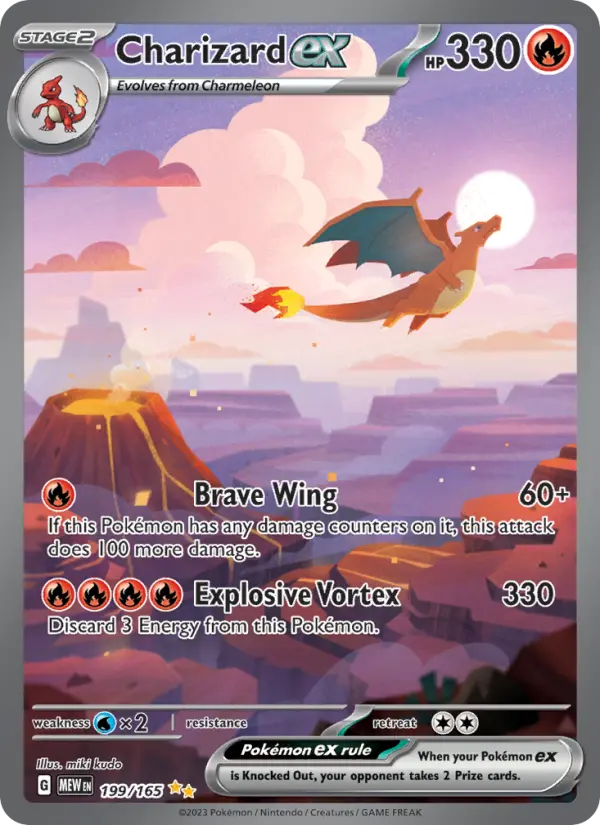
The price impact is direct and proportional: cards exclusive to Tier S decks (especially the main Pokemon ex/VSTAR and their specific supporters) are the most expensive in the format. For example, a Charizard ex 199/165 (Special Illustration Rare) from 151 trades around $90 partly due to its competitive dominance, while a card of equivalent rarity featuring a less-played Pokemon sells for $15-25.
Impact of rotations on prices
The Standard format rotation is arguably the single most impactful event for competitive card prices. Each year, typically in April, The Pokemon Company removes the oldest sets from Standard format, keeping only the two or three most recent years of sets. This mechanism forces deck renewal and prevents the same cards from dominating indefinitely.
The price impact of rotations follows a predictable three-phase pattern:
- Anticipation phase (2-3 months before) -- As soon as the rotation is announced, cards about to leave the format start losing value. Players sell their copies in advance, creating downward pressure. This is when savvy speculators begin watching cards from upcoming sets that could replace outgoing staples.
- Drop phase (rotation day) -- Cards leaving Standard format instantly lose a large portion of their competitive value. A staple card worth $15 can fall to $3-5 if its only value was tied to gameplay. Meanwhile, cards that remain in format and gain relative importance see their prices rise.
- Stabilization phase (1-2 months after) -- The new meta takes shape. The first decklists emerge, players test new strategies, and prices stabilize at their new levels. This is often the best time to buy cards for the new format at reasonable prices, before tournament results drive up the prices of winning decks.
The ban list: an unpredictable earthquake
Unlike rotations, bans are unpredictable and their price effects are brutal. When The Pokemon Company decides to ban a card from Standard format (typically because it is deemed too powerful or toxic for the game), the announcement triggers an immediate and severe price drop. The most striking recent example is the Forest Seal Stone ban in 2024, which caused the card to lose approximately 70% of its value within a week. Conversely, cards that were "kept in check" by the banned card often see their prices rise, as they suddenly become viable in the new meta.
Trainer/Supporter cards: underrated but essential
Beginning collectors and investors often make the mistake of only focusing on Pokemon cards (the creatures), ignoring Trainer and Supporter cards entirely. This is a major strategic error, as these cards often form the backbone of competitive decks and represent some of the best value-for-money plays on the market.
A typical competitive deck contains about 60 cards, with usually 15-20 Pokemon cards and 30-40 Trainer/Supporter/Tool/Stadium cards. Supporters like Professor Sada's Vitality, Boss's Orders, Iono, and Arven are played in virtually every meta deck, creating massive cross-deck demand. Unlike a specific Pokemon that is only relevant to one or two decks, a universal Supporter is needed by every competitive player.
The most striking example is Iono (Paldea Evolved). This Supporter card, played as a 3-4 copy in nearly every competitive deck, has seen its Special Illustration Rare version reach remarkable prices -- around $25-35 for a card that doesn't stand out for its rarity but for its universal competitive demand. In comparison, many Pokemon ex from the same set, theoretically rarer, sell for less because they aren't played in tournaments.
Stadium cards also deserve special attention. Stadiums like Artazon or Path to the Peak (before its rotation) have demonstrated that Trainer cards can have an enormous impact on the game and, consequently, on prices. Path to the Peak was one of the most expensive cards in its set throughout its Standard lifespan, purely because of its competitive power.
Eternal "staples" vs cyclical cards
In competitive jargon, a "staple" is a card so fundamental that it's played in the majority of decks. It's essential to distinguish two categories of staples that have very different price trajectories.
Universal staples (lasting value)
Some cards are designed to be pillars of the format for their entire Standard lifespan. They're played in 2-4 copies in 80-100% of competitive decks. Their price remains high and stable as long as they're legal in format.
- Boss's Orders -- Reprinted in every generation since its creation, this Supporter that forces a benched Pokemon into the active spot is an absolute staple of competitive play. Each version with different artwork has a different value, but demand remains constant.
- Iono -- The disruption Supporter of the Scarlet & Violet era. Played as a 3-4 copy in every deck, its Special Illustration Rare version holds above $25.
- Rare Candy -- A historic staple, reprinted dozens of times, essential in any deck built around Stage 2 evolutions. Its older versions (notably from the original ex era) have acquired collectible value on top of their play value.
- Ultra Ball -- Another historic staple reprinted regularly, played as a 4-of in virtually every deck. Its Gold Rare versions reach premium prices.
Cyclical staples (temporary value)
Other cards dominate the meta for a season or two, then disappear with rotation or the emergence of a better replacement. Their price follows a bell curve: rapid rise, plateau, then drop.
| Card | Peak price (in meta) | Post-rotation price | Change |
|---|---|---|---|
| Forest Seal Stone | $20 | $3 | -85% |
| Arceus VSTAR (Gold) | $50 | $12 | -76% |
| Comfey (Lost Zone) | $8 | $0.50 | -94% |
| Battle VIP Pass | $13 | $1.50 | -88% |
| Lumineon V | $15 | $2 | -87% |
The table above illustrates a crucial point: cards whose value rests solely on competitive play are depreciating assets. They can be excellent for short-term trading (buy when a deck emerges, sell before rotation), but they don't constitute reliable long-term investments. For lasting value, it's better to focus on cards that combine competitive and collectible value, or on purely collectible cards of high value.
Top 10 most expensive competitive cards in 2026
This ranking lists cards that derive a significant portion of their value from competitive tournament play (not solely from rarity or collectibility). Prices shown are market estimates in US dollars for near-mint copies as of publication date.
Notice that Supporter cards (Iono, Boss's Orders, Arven) hold places as prominent as the star Pokemon in this ranking. This confirms the importance of not overlooking Trainer cards in a competitive investment strategy. Also note that these prices are for the most premium versions (Special Illustration Rare, Gold Rare); the regular versions of these same cards sell for significantly less.
Staff cards and prizes: the Holy Grail for competitive collectors
Beyond playable cards, the Pokemon competitive circuit generates collectibles that are truly one of a kind: staff cards, prize cards, and tournament-exclusive products. These pieces represent the ultimate convergence of the competitive world and the collecting world.
Staff Cards
At every official tournament, judges, organizers, and staff members receive special promotional cards bearing a holographic "STAFF" stamp printed on the card face. These cards are strictly identical to the promo cards distributed to participants, except for this distinctive marking. Their rarity is extreme: for a Regional with 1,000 players, there are typically only 30-60 staff members, meaning staff cards are produced in tiny quantities.
The most sought-after staff cards are from the World Championships and Internationals, as they combine event prestige with maximum rarity. A Worlds staff card can sell for between $200 and $2,000 depending on the year, the Pokemon featured, and condition. Vintage staff cards (pre-2015) are even rarer because fewer people kept them in good condition. US-based collectors have a particular advantage as many Regionals and the NAIC take place in the United States, making it relatively easier to network with staff and acquire these cards.
Championship Prize Cards
World Champions and finalists receive exclusive trophy cards available nowhere else. These cards, often numbered and in ultra-limited quantities, are among the most coveted items on the market. The Champion's Festival from Worlds, distributed only to Main Event participants, has become a must-have for competitive collectors. The oldest versions (2004-2010) can exceed $5,000.
The No. 1 Trainer, No. 2 Trainer, and No. 3 Trainer trophies from the earliest Japanese tournaments (1997-1999) are now museum pieces. The No. 1 Trainer Trophy Card from the 1999 Super Secret Battle, of which only 7 copies exist, sold at auction for over $90,000. For more on these exceptional cards, see our ranking of the most expensive Pokemon cards in the world.
Tournament-exclusive products
Beyond cards, competitive events offer exclusive merchandise: official playmats, deck boxes, sleeves, and pins. These items, produced in limited quantities and available only on-site, have developed their own secondary market. A 2024 Worlds Honolulu playmat already resells for $80-150. Playmats from the oldest Worlds events (2004-2008) exceed $500.
How to anticipate price movements
For competitive card investors and traders, the ability to anticipate price movements is the most valuable skill. Here are the four key moments to watch and the tools to track them.
1. Spoiler season (new set reveals)
Two to four weeks before a new set release, cards are revealed gradually -- first in Japan (which is typically one month ahead), then for the international market. This is when experienced players begin evaluating the potential impact of new cards on the meta. If a card seems capable of creating a new Tier 1 deck or strengthening an existing one, its pre-order price skyrockets -- and cards it might render obsolete begin to drop.
Pro tip: follow Japanese spoilers on pokemoncard.io and pro player reactions on social media. Analysis articles from sites like Limitless TCG and videos from high-level players are invaluable indicators.
2. Tournament results
Real-time tournament results are the most powerful catalyst for price movements. Decks that reach Top 8 at a Regional or Top 4 at an International systematically see their key cards gain value. Essential tools:
- Limitless TCG -- The absolute reference for tournament results, decklists, and meta statistics. Updated in real time during events.
- RK9 Labs -- The official Pokemon tournament management tool, which publishes results and pairings live.
- Twitch/YouTube streams -- Major tournaments are broadcast live on the official Pokemon channel and by community commentators. Following streams lets you react immediately to surprises.
3. Rotation and ban announcements
TPCi typically announces format rotations 2-3 months before they take effect. Bans, however, are unpredictable -- they can be announced at any time via an official press release. Follow official channels (official Pokemon site) and community Twitter/X accounts to be informed first.
4. The "buy the rumor, sell the news" effect
This classic stock market principle applies perfectly to the competitive card market. Prices often rise more on anticipation than on confirmation. When a promising new deck is theorized on social media, the prices of relevant cards start climbing. When the deck proves its worth at a tournament, prices have often already reached a plateau. And when "everyone knows" a deck is Tier 1, it's usually too late to buy at a good price. The best prices are found in the window between a promising card's spoiler and its first major tournament performance.
| Card | Pre-tournament price | Post-win price | Change |
|---|---|---|---|
| Charizard ex (151) | $38 | $90 | +137% |
| Dragapult ex (Twilight Masq.) | $13 | $30 | +131% |
| Raging Bolt ex (Temporal F.) | $6 | $16 | +167% |
| Iron Hands ex (Paradox Rift) | $4 | $15 | +275% |
| Iono (Paldea Evolved SAR) | $16 | $35 | +119% |
Competitive value vs collectible value: two distinct markets
To wrap up our analysis, it is fundamental to clearly distinguish between these two sources of value that coexist in the Pokemon card market. Each follows its own rules, its own cycles, and its own risk factors.
Competitive Value
- Based on tournament utility
- Fluctuates with meta and rotations
- Short-term horizon (1-2 seasons)
- Affected by bans and reprints
- High volatility, quick gains possible
- Regular version suffices (no need for premium)
- Demand: competitive players
Collectible Value
- Based on rarity, artwork, nostalgia
- Stable and growing long-term
- Long-term horizon (5-20+ years)
- Unaffected by bans and rotations
- Low volatility, steady growth
- Premium versions sought (PSA 10, 1st Ed.)
- Demand: collectors, investors
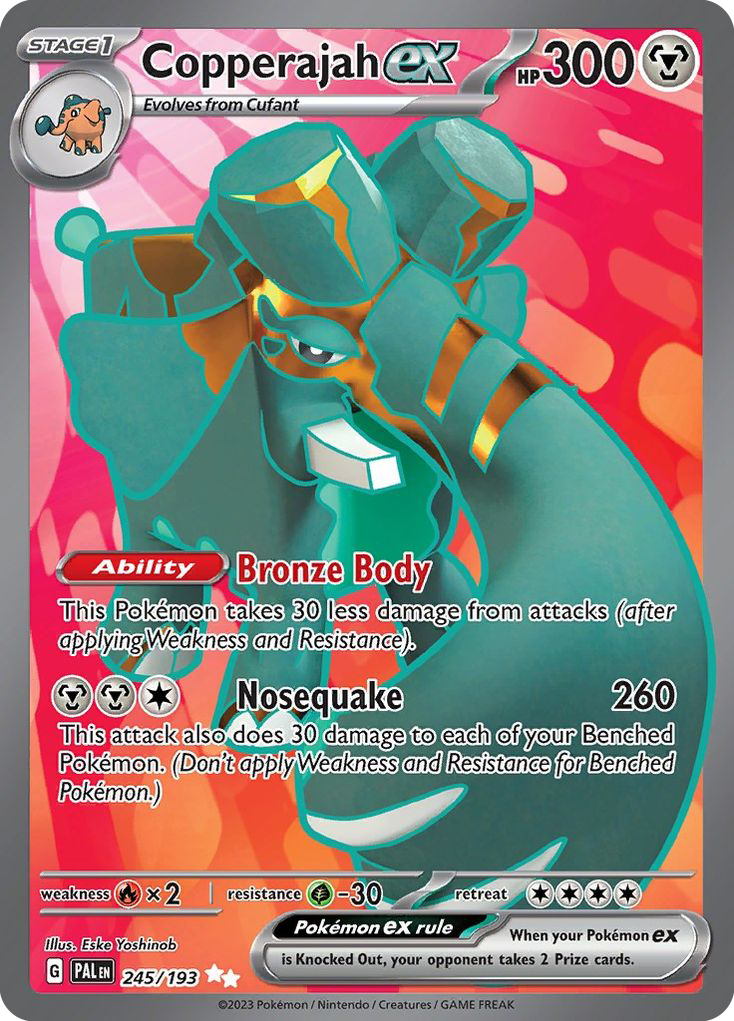
The most interesting cards are those that combine both forms of value. A Charizard ex Special Illustration Rare benefits from competitive demand (Tier S deck) AND collectible demand (iconic Pokemon, exceptional artwork). Even when this Charizard ex eventually rotates out of Standard, its collectible value will maintain a solid price floor. Conversely, a Trainer card like Night Stretcher, however dominant it may be competitively, will have virtually no collectible value once it leaves the meta.
For a balanced investment strategy, we recommend a hybrid approach: use competitive knowledge for short-term trading (buy before spikes, sell before rotations) while building a portfolio of premium collectible pieces for the long term. Vintage Wizard cards, premium variants, and high-grade certified cards remain the best investments on a 5-10 year horizon, regardless of any competitive considerations. Check out our detailed advice in our complete Pokemon card investment guide.
Sources and references
- Limitless TCG -- Tournament data, decklists and competitive metagame statistics for Pokemon TCG
- RK9 Labs -- Official Pokemon tournament management platform (live pairings and results)
- The Pokemon Company -- Official rules, Standard format rotation announcements and banned card list
- TCGPlayer -- Leading marketplace for Pokemon card pricing (North American market)
- Cardmarket -- European market prices for Pokemon TCG singles and market trends
- PriceCharting -- Historical price data and market trends for Pokemon cards
- Bulbapedia -- Comprehensive community encyclopedia on the Pokemon universe and card history
- PokeBeach -- News, new set spoilers and competitive play analysis