In February 2026, a Pokemon card sold for $16.5 million. Not a masterpiece painting, not a rough diamond, not a medieval manuscript. A 2.5-by-3.5-inch piece of cardboard printed in Japan in 1998. The figure made headlines worldwide and propelled Pokemon cards into a stratosphere no one could have imagined just ten years ago.
But the Pikachu Illustrator is only the tip of the iceberg. Behind this absolute record lies a structured market, complete with auction houses, grading organizations and collectors ready to invest staggering sums in cards that each tell, in their own way, a chapter of Pokemon history.
In this guide, we have gathered the 15 most expensive Pokemon cards ever sold at public auction. Every price cited comes from a verifiable sale at Goldin Auctions, Heritage Auctions or PWCC Marketplace. No rumors, no estimates: facts only.
The ranking: Top 15 most expensive cards
Before diving into each card in detail, here is the summary table. All amounts include the buyer's premium as reported by the auction houses.
| # | Card | Grade | Price | Auction House | Date |
|---|---|---|---|---|---|
| 1 | Pikachu Illustrator | PSA 10 | $16,492,000 | Goldin | Feb. 2026 |
| 2 | Pikachu Illustrator | PSA 9 | $5,275,000 | Goldin (private) | Jul. 2021 |
| 3 | Pikachu Illustrator | CGC 8.5 | $900,000 | Goldin | Feb. 2022 |
| 4 | Charizard 1st Ed. Base Set | PSA 10 | $550,000 | Heritage Auctions | Dec. 2025 |
| 5 | Topsun Charizard Blue Back | PSA 10 | $493,230 | Goldin | Jan. 2021 |
| 6 | No. 1 Trainer Pikachu Trophy (Gold) | PSA 9 | $450,000 | Heritage Auctions | Dec. 2025 |
| 7 | No. 2 Trainer Pikachu Trophy (Silver) | PSA 10 | $444,000 | Goldin | 2023 |
| 8 | Charizard 1st Ed. Shadowless | PSA 10 | $420,000 | PWCC | 2022 |
| 9 | Blastoise Presentation Galaxy Star | CGC 8.5 | $360,000 | Heritage Auctions | Jan. 2021 |
| 10 | Ishihara GX Signed | PSA 10 | $247,230 | Goldin | Apr. 2021 |
| 11 | Snap Bulbasaur | PSA 9 | $200,000 | Private sale | Mid-2025 |
| 12 | Kangaskhan Family Event Trophy | PSA 10 | $150,000 | Goldin | Oct. 2020 |
| 13 | No. 2 Trainer Trophy 1997 | CGC 10 | $132,000 | PWCC | Sep. 2023 |
| 14 | Super Secret Battle No. 1 Trainer | PSA 10 | $90,000 | Heritage Auctions | Jul. 2020 |
| 15 | Blastoise 1st Ed. Base Set | PSA 10 | $88,000 | eBay | Jul. 2025 |
#1 — Pikachu Illustrator PSA 10: $16.49 million
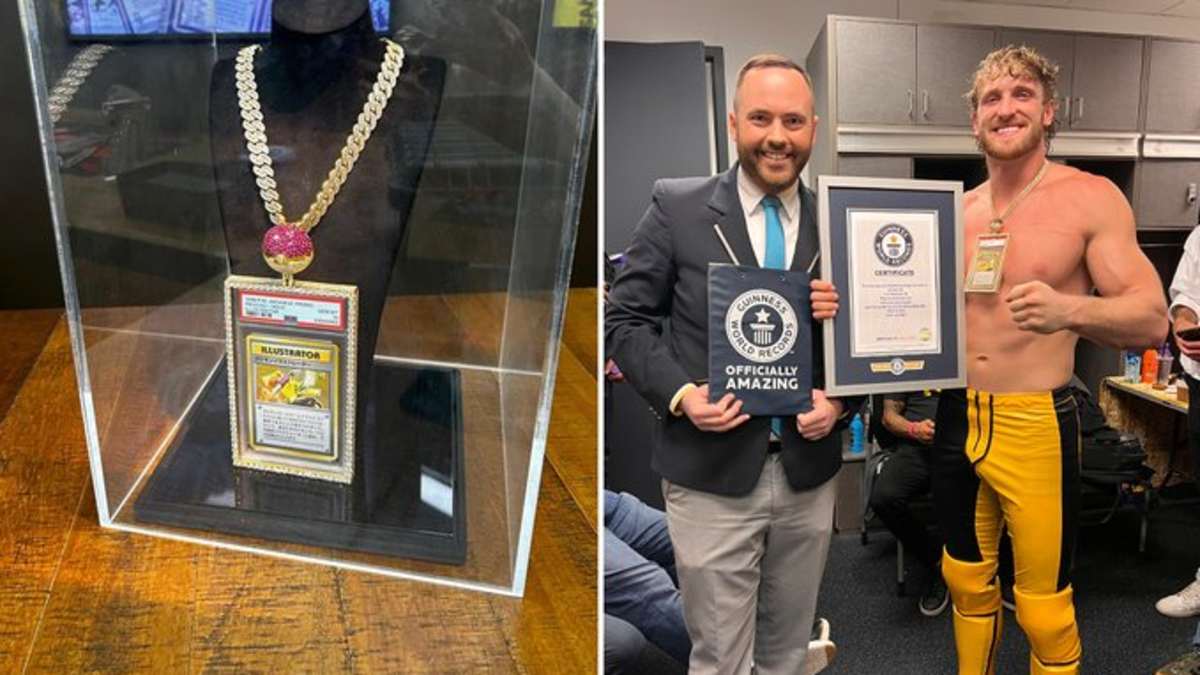
On February 16, 2026, after 41 days of bidding and 97 offers placed, Logan Paul's Pikachu Illustrator PSA 10 card changed hands for $16,492,000. The buyer, AJ Scaramucci (son of businessman Anthony Scaramucci and founder of Solari Capital), received the card directly from Paul's hands in a ceremony broadcast live.
The final hammer price was $13.3 million, to which Goldin's 24% buyer's premium was added, bringing the total to nearly $16.5 million. A Guinness World Records judge was present to certify a double record: the most expensive Pokemon card and the most expensive trading card ever sold at auction, across all categories.
To learn more about this historic sale, read our full article on the Pikachu Illustrator record.
Pikachu Illustrator by the numbers
Why is this card worth so much?
Three factors converge to explain this extraordinary price:
- Extreme rarity: Only 39 copies were distributed between 1997 and 1998 during three illustration contests run by the Japanese magazine CoroCoro Comic. Only one copy has ever achieved the perfect PSA 10 (Gem Mint) grade.
- Historical significance: It is the only Pokemon card to bear the title "Illustrator" instead of "Trainer." The illustration was created by Atsuko Nishida, the original designer of Pikachu at Game Freak.
- Media effect: Logan Paul's celebrity, the chain of records ($5.275M in 2021 then $16.5M in 2026) and coverage by CNN, BBC and the Guinness World Records catapulted this card into mainstream culture.
#2 to #5 — The $400,000+ club
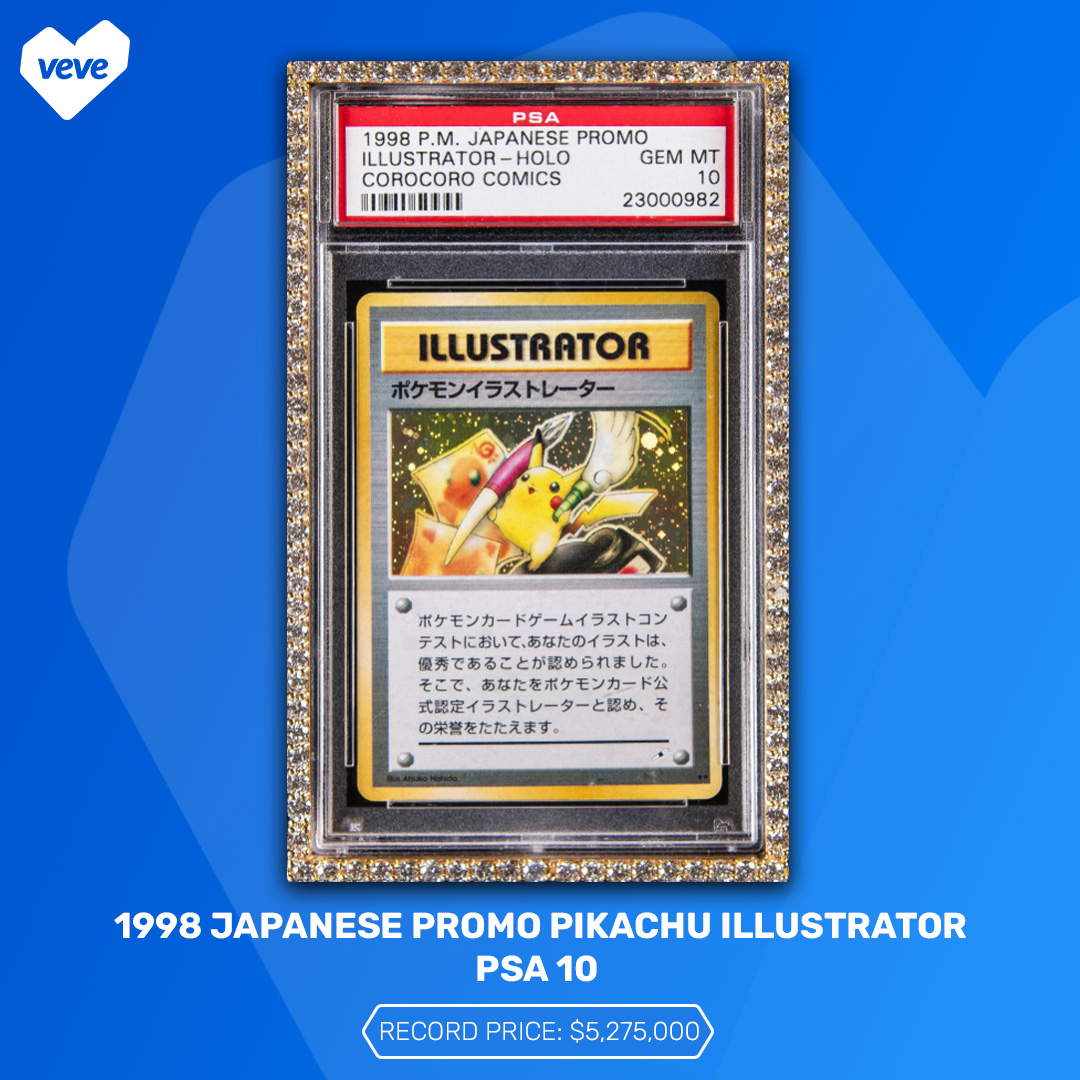
#2 — Pikachu Illustrator PSA 9: $5,275,000
In July 2021, Logan Paul acquired this card as part of a complex exchange valued at $5.275 million: a Pikachu Illustrator PSA 9 (estimated at $1.275 million) plus $4 million in cash. At the time, it was the all-time record for a Pokemon card. Paul later had the card regraded, obtaining the famous PSA 10 that would sell five years later for three times that amount.
This example illustrates a fascinating phenomenon: regrading a card can potentially turn a $5 million investment into $16 million. But beware — jumping from PSA 9 to PSA 10 is extremely rare, and it is likely that specific factors (authorized professional cleaning, optimal submission conditions) worked in Paul's favor.
#3 — Pikachu Illustrator CGC 8.5: $900,000
Another copy of the Pikachu Illustrator, graded CGC 8.5 (Near Mint/Mint+), sold for $900,000 at Goldin in February 2022. This price confirms that even below a perfect grade, this card remains in a league of its own. With 15 copies graded PSA 9 and a handful in lower grades, supply remains negligible against worldwide demand.
The Pikachu Illustrator alone occupies the top three spots in this ranking. This is a unique case in the history of trading cards: no other card, in any universe (Magic, Yu-Gi-Oh!, sports), dominates the top of the market so completely.
#4 — Charizard 1st Edition Base Set PSA 10: $550,000
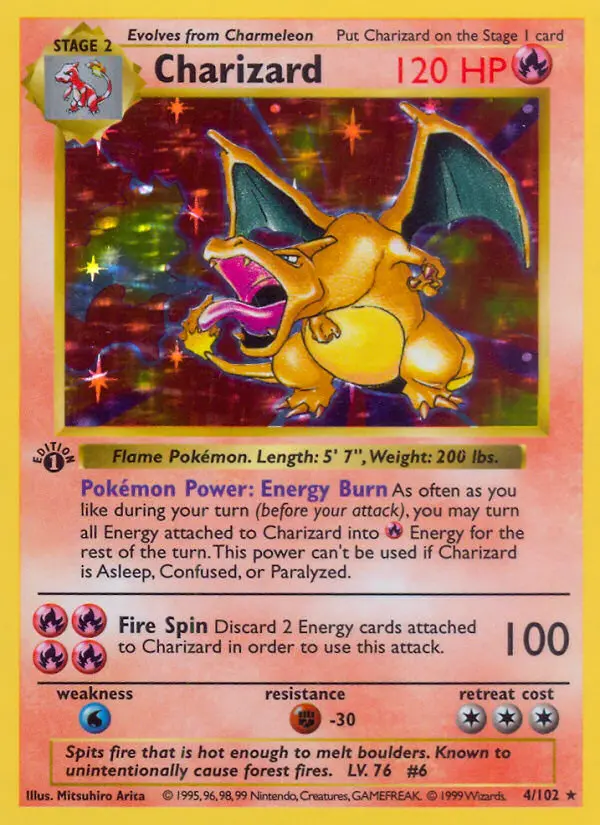
Charizard remains the most iconic Pokemon card in the world. On December 12, 2025, a 1st Edition Base Set copy graded PSA 10 Gem Mint reached $550,000 at Heritage Auctions, during a signature sale that totaled $5.27 million for Pokemon cards alone — a house record.
This sale surpassed the previous record of $420,000 set in 2022 at PWCC, confirming the upward trajectory of this legendary card. By comparison, a Charizard 1st Edition PSA 9 currently trades between $45,000 and $80,000. The price ratio between a PSA 9 and a PSA 10 hovers around x7 to x10, a phenomenon typical of iconic cards with limited PSA 10 populations.
For a detailed analysis of the Charizard's value over the years, check out our complete guide to the Charizard price evolution.
#5 — Topsun Charizard Blue Back PSA 10: $493,230
Before the Pokemon TCG even officially existed, the Japanese company Topsun produced a series of promotional cards in 1997, sold alongside chewing gum. The "Blue Back" Charizard (named after the color of its reverse side) is the oldest Charizard in circulation, predating the Base Set by a full year.
A PSA 10 copy sold for $493,230 at Goldin in January 2021. What makes this card even more fascinating is that it exists in two variants: the standard version and the numberless version (a printing error). The latter is even rarer and commands premium prices among Japanese collectors, who consider it the true "first Charizard."
#6 to #9 — Trophies and museum-grade rarities
The cards in this tier share a common trait: they were never sold in stores. They are tournament prizes, prototypes or private gifts. Artifacts, in the near-archaeological sense of the word.
#6 — No. 1 Trainer Pikachu Trophy (Gold) PSA 9: $450,000
The Trophy No. 1, No. 2 and No. 3 Trainer cards were awarded to first, second and third place finishers at the very first official Pokemon tournament held in Japan in 1997. The gold No. 1 Trainer, given to the champion, is the stuff of legend.
A PSA 9 copy reached $450,000 at Heritage Auctions in December 2025. Approximately 15 copies are believed to have been distributed in total (9 in the Junior category, 6 in the Senior category). The number of surviving copies in gradable condition is even lower. The illustration, by Mitsuhiro Arita (the same artist who drew the original Charizard), depicts Pikachu proudly holding a gold trophy.
#7 — No. 2 Trainer Pikachu Trophy (Silver) PSA 10: $444,000
The silver version of the Trophy Pikachu, awarded to the runner-up, reached $444,000 in 2023 at Goldin. A perfect PSA 10 grade on a card over 25 years old, distributed only in person at a Japanese event — that is an alignment of stars that virtually never occurs.
For trophy collectors, these cards represent the "Japanese Holy Grail": tangible proof that the Pokemon TCG began as a schoolyard phenomenon in Tokyo before conquering the planet.
#8 — Charizard Shadowless 1st Ed. PSA 10: $420,000
Before the $550,000 record in December 2025, the previous high for a Charizard was $420,000, achieved at PWCC Marketplace in 2022. The "Shadowless" version of the 1999 Base Set is distinguished by the absence of a drop shadow around the card's border, a sign of an early and therefore rarer print run.
The fact that the record was broken three years later ($550,000 in December 2025) confirms the strength of the bullish trend for PSA 10 1st Edition Charizards.
#9 — Blastoise Presentation Galaxy Star CGC 8.5: $360,000
This card is not a Pokemon card in the traditional sense: it is a pre-production prototype created in 1998 when Wizards of the Coast was preparing the English adaptation of the Pokemon TCG. It is a Blastoise with a unique "Galaxy Star" hologram, printed on presentation paper with a blank reverse.
Only two copies are known to exist. One of them, graded CGC 8.5 (Near Mint/Mint+), sold for $360,000 at Heritage Auctions on January 14, 2021. A second copy, with a Magic: The Gathering reverse (the other Wizards card game), sold for $216,000 that same year. These are museum pieces in the literal sense, documenting the birth of the English-language Pokemon TCG.
Legendary Tier
Pikachu Illustrator
$500,000 — $16.5M
Fewer than 40 copies
Ultra-Rare Tier
Trophy Cards, Prototypes
$100,000 — $500,000
2 to 15 known copies
Premium Tier
1st Ed. PSA 10 (Charizard, etc.)
$40,000 — $550,000
Dozens of PSA 10 copies
#10 to #15 — The prestigious outsiders
#10 — Ishihara GX Signed PSA 10: $247,230
This promotional GX card features Tsunekazu Ishihara, the president of The Pokemon Company, alongside a Master Ball and a Rotom. Distributed exclusively to Ishihara's close associates at an internal event, it is estimated that between 30 and 200 copies exist in total.
The copy sold at Goldin in April 2021 also bore the president's autograph signature, which drove the price to $247,230. For perspective, an unsigned PSA 10 copy had sold for $50,000 on eBay. The signature therefore multiplied the value by x5.
#11 — Snap Bulbasaur PSA 9: $200,000
The surprise of 2025. This Bulbasaur from the Pokemon Snap video game (1999) sold for approximately $200,000 in a private sale in mid-2025, becoming the most expensive Bulbasaur ever sold. A card that nobody saw coming in the top rankings.
This sale illustrates an interesting market phenomenon: certain "sleeper" cards, rarely in the spotlight but extremely rare, can suddenly skyrocket when a determined collector decides to acquire them at any cost.
#12 — Kangaskhan Family Event Trophy PSA 10: $150,000
In 1998, the first Pokemon "Parent-Child" (Family Event) was organized in Japan. Participants received this holographic Kangaskhan card as a prize. Less rare than tournament cards (several hundred copies distributed), a perfect PSA 10 remains nonetheless exceptionally hard to find on a card from this era. A copy sold for $150,000 at Goldin in October 2020.
This card holds a special place in the hearts of Japanese collectors: it symbolizes the earliest days of the Pokemon community, when parents and children played together at events held in Japanese shopping centers.
#13 — No. 2 Trainer Trophy 1997 CGC 10: $132,000
Another copy of the No. 2 Trophy card, this time from the Lizardon (Charizard) Mega Battle tournament in 1997, sold for $132,000 at PWCC in September 2023. Graded CGC Pristine 10, it is one of the few perfect copies of these Japanese tournament cards.
The coexistence of PSA and CGC grades in this ranking is worth noting. Both organizations have their supporters, and certain cards achieve better grades with one or the other. To understand the differences, check out our detailed PSA vs CGC comparison.
#14 — Super Secret Battle No. 1 Trainer PSA 10: $90,000
In 1999, seven regional "Super Secret Battle" tournaments were held in Japan, and only the winners received this card. The result: 7 known copies worldwide. The card depicts a holographic silhouette of Mewtwo against a starry sky, with artwork by Hideki Kazama. The finals took place in Tokyo on August 22, 1999.
In July 2020, a PSA 10 Gem Mint copy sold for $90,000 at Heritage Auctions. PSA has certified 7 copies of this card, with 6 achieving the perfect grade of 10. Given the market explosion since 2020, a sale today would likely reach a significant multiple of that price.
#15 — Blastoise 1st Edition Base Set PSA 10: $88,000
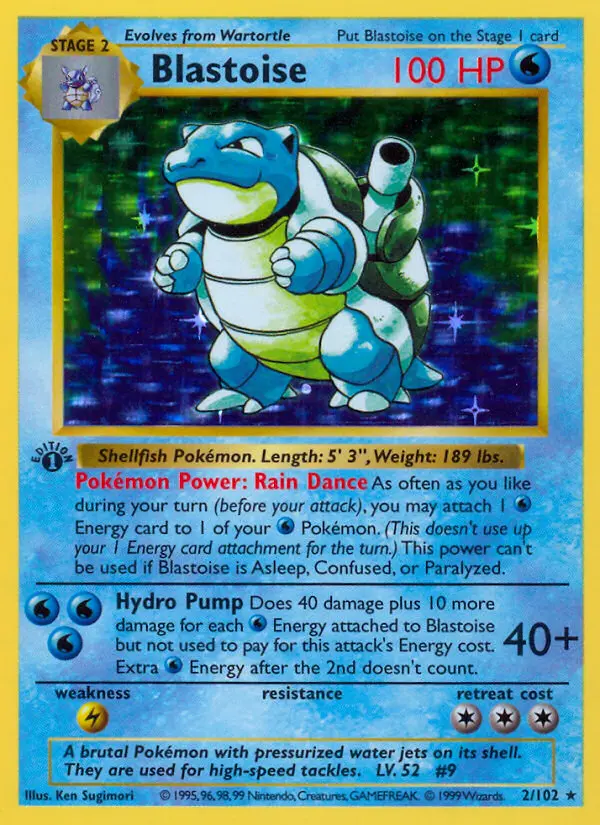
The Blastoise 1st Edition Base Set graded PSA 10 Gem Mint sold for $88,000 via eBay in July 2025. Less publicized than its eternal rival Charizard, Blastoise remains one of the three original starters and its PSA 10 value has climbed steadily.
For collectors looking for an entry point into high-end vintage cards, the Blastoise 1st Edition is a solid choice: same pedigree (Generation 1, Base Set, holo), but at a significantly more accessible price than Charizard. If you are looking to invest in Pokemon cards in 2026, this is a segment worth watching.
Record timeline: from the first million to sixteen million
The dizzying ascent of Pokemon card prices did not happen overnight. Here is a decade of records that reshaped the market, from the first six-figure sale to the all-time record of February 2026.
A Charizard PSA 10 breaks the $200,000 barrier at Iconic Auctions. The Pokemon card market enters the radar of major collectors and financial media.
Heritage Auctions sells one of the 7 rarest cards in the world. The community realizes that Japanese tournament cards constitute a segment of their own, long underestimated by Western collectors.
Two major sales at Heritage and Goldin in a single month. Prototypes and pre-production cards enter the $500,000 club. The Pokemon card market catches the attention of mainstream international press.
Logan Paul breaks the $5 million barrier for a single Pokemon card. The record is certified by Guinness and publicized worldwide. He would later regrade the card from PSA 9 to PSA 10, a bet that proved extraordinarily profitable.
Heritage Auctions breaks its own records with a Pokemon sale totaling $5.27 million. The Charizard and Trophy Pikachu sell at never-before-seen levels, confirming the bullish market trend after the 2023 trough.
All-time record, certified by Guinness World Records. The most expensive Pokemon card in history is also the most expensive trading card ever sold at auction, across all categories. AJ Scaramucci prevails after 41 days of bidding and 97 offers.
What makes a Pokemon card so expensive?
Behind every six- or seven-figure price tag, you will find a combination of factors that determine a card's value. Understanding these dynamics means better grasping the market — whether you are a collector, an investor or simply curious.
1. Rarity
This is the most obvious factor, but it is not enough on its own. The most expensive cards are almost always ultra-limited print run pieces: 39 Pikachu Illustrators, 7 Super Secret Battles, 2 Blastoise Presentations. However, a rare card of an obscure Pokemon will never be worth as much as a Charizard or a Pikachu, even with an identical print run. Rarity must be combined with other factors to create exceptional value.
2. Grade (condition)
Grading by PSA, CGC or Beckett has become a requirement for high-value cards. The price gap between grades can be staggering: a Charizard 1st Edition PSA 9 is worth about $50,000, while a PSA 10 reaches $550,000. A x10 ratio between a PSA 9 and a PSA 10 is common for iconic cards.
This multiplier is explained by PSA population statistics. Out of the hundreds of Charizard 1st Editions submitted to PSA, only a tiny minority achieves the perfect grade of 10. Each PSA 10 therefore represents the cream of the crop of an already rare card.
3. Pokemon popularity
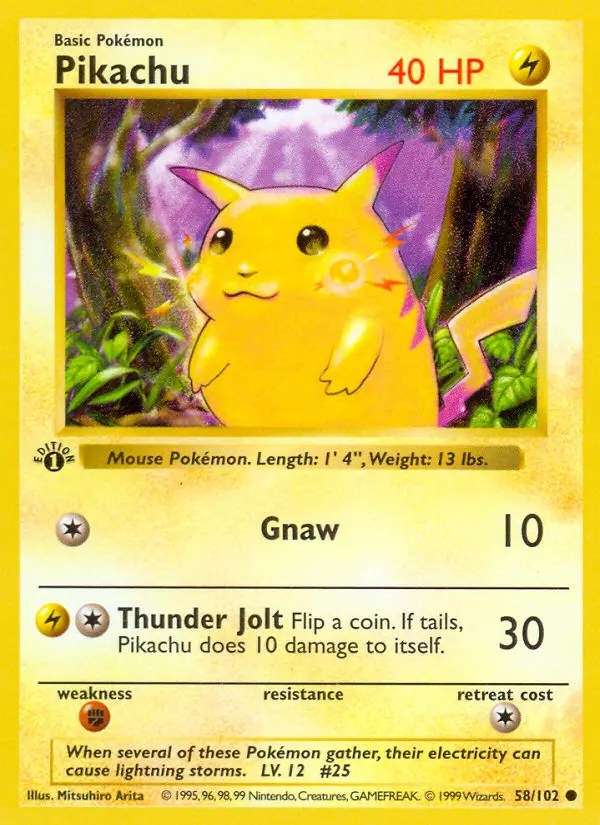
Pikachu and Charizard dominate this ranking, and that is no coincidence. These two Pokemon enjoy worldwide recognition that extends far beyond the TCG player base. When a newcomer thinks "expensive Pokemon card," they think Charizard. This mainstream fame sustains demand and drives prices higher, in a virtuous circle that benefits the most emblematic cards.
4. Provenance and history
A card with a story to tell is worth more than one without provenance. The Pikachu Illustrator was a children's illustration contest prize. The Trophy Cards rewarded the first tournament champions. The Blastoise Presentation is a prototype documenting the birth of the English-language TCG. Each of these cards is a cultural artifact as much as a collectible item. To understand these origins, dive into our article on the origins of Pokemon cards in Japan.
5. Market effects and media coverage
The role of personalities like Logan Paul, and more broadly the media coverage of record sales, has a ripple effect across the entire market. Each record attracts new buyers, which drives prices up in a cascade. The global trading card games market is estimated at $14.7 billion in 2025, with projections of $16.9 billion by 2035 according to Global Market Insights.
The Pokemon market by the numbers (2024-2026)
The 3 major categories of luxury cards
Analyzing this ranking, three broad categories emerge. Each follows a different market logic and attracts a distinct type of collector.
Category 1: Japanese tournament and promotional cards
Pikachu Illustrator, Trophy Cards No. 1/2/3, Super Secret Battle, Kangaskhan Family Event... These cards were never sold in stores. Distributed at specific events in Japan between 1997 and 1999, they represent the aristocracy of the Pokemon world. Their print runs are counted in dozens, sometimes in single digits.
To understand the significance of these original Japanese cards compared to Western versions, remember that the Pokemon TCG was born in Japan a year before it reached the West. The very first cards, the very first tournaments: that is where it all began, and these cards are the tangible proof.
Category 2: Base Set 1st Editions in perfect grade
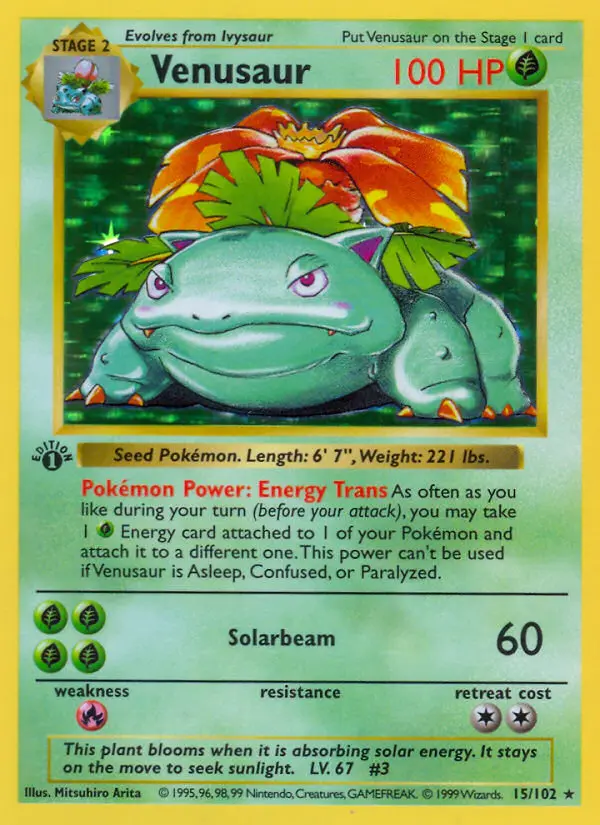
Charizard, Blastoise, Venusaur... The holos from the first edition Base Set (Wizard block) are the beating heart of the market. Their strength: they are well-known enough to attract a broad audience, yet rare enough in PSA 10 to sustain high prices. The Charizard 1st Edition PSA 10 is arguably the most coveted card in the world, a status its $550,000 price tag confirms.
Category 3: Prototypes and printing errors
The Blastoise Presentation Galaxy Star and the Topsun Charizard Blue Back fall into this category. They are unique or near-unique objects that tell the story of how Pokemon cards were made. A prototype tested by Wizards of the Coast in 1998, a Charizard printed before the TCG's official launch: these cards are museum pieces documenting the behind-the-scenes of a cultural phenomenon. To learn more about cards printed with anomalies, check our guide on Pokemon card errors and misprints.
Honorable mentions: cards knocking on the Top 15 door
The market for rare Pokemon cards does not stop at our ranking. Here are a few cards whose prices continue to climb and that could soon break into the top tier.
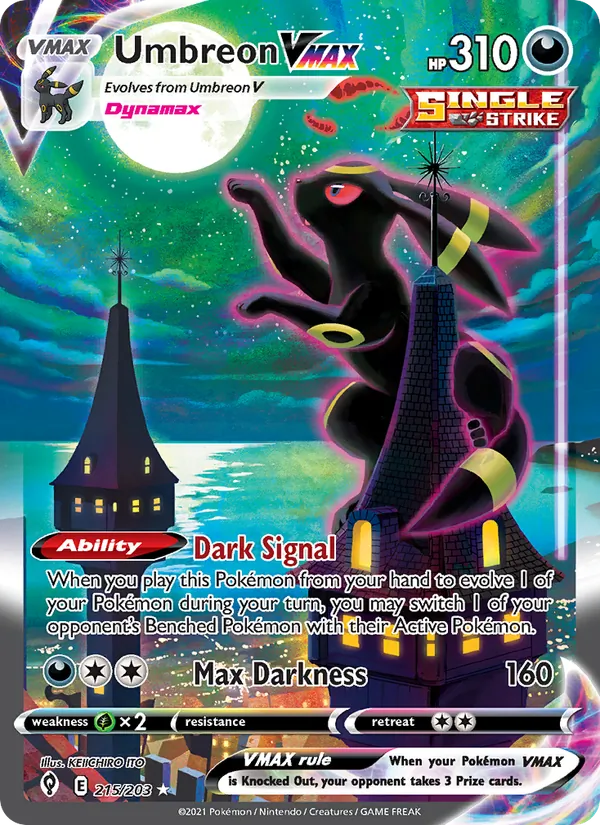
- Gold Star Umbreon (POP Series 5, PSA 9): Sold for $17,600 in August 2025. The Gold Star cards from the EX era, recognizable by their gold star and full-art illustration, now rival Base Set holos in terms of desirability.
- Gold Star Espeon (PLAY Japanese promo, PSA 10): The Espeon counterpart, distributed through the Japanese PLAY loyalty program, is extremely rare in high grade. Heritage Auctions sold a copy in late 2024.
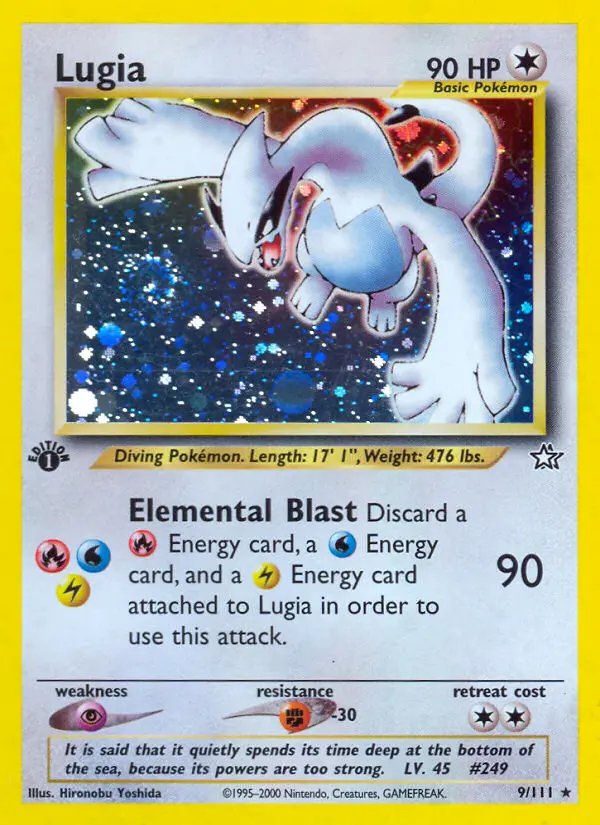
- Lugia 1st Ed. Neo Genesis PSA 10: At $45,000 in October 2024, Lugia is the most expensive card outside the Base Set. Its value doubled in under a year ($22,800 in December 2023).
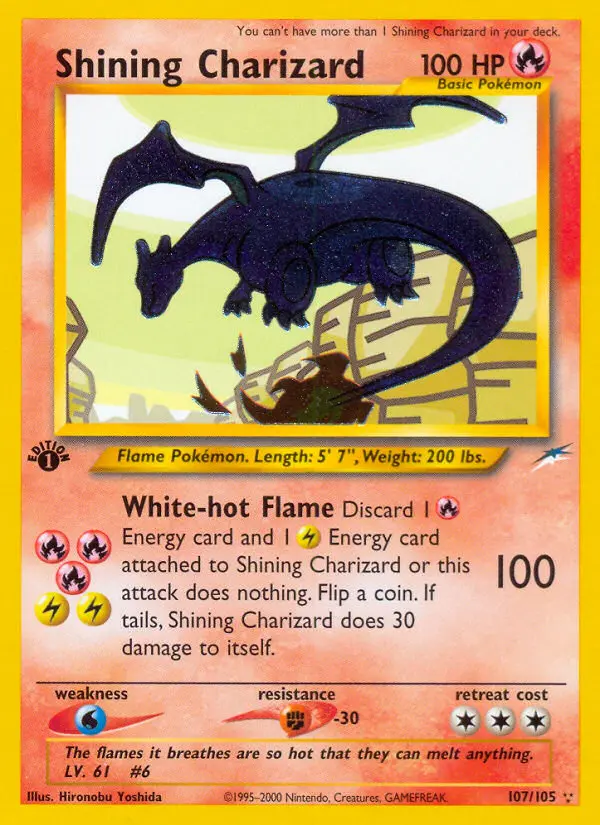
- Shining Charizard (Neo Destiny, PSA 10): The "Shining Charizard" from the Neo Destiny set combines the Pokemon's iconic status with a spectacular illustration. A PSA 10 was worth about $15,000 in 2022, but prices have risen significantly since.
- French Charizard 1st Edition PSA 10: French Base Set cards in high grade have become a highly sought-after niche segment. Our guide on the rarest French cards covers this booming market in detail.
Investing in Pokemon cards in 2026: opportunity or bubble?
With a record at $16.5 million and a global market exceeding $2 billion, it is tempting to view Pokemon cards as a serious investment. But should you take the plunge? Here is a nuanced analysis.
Positive signals
- Pokemon's 30th anniversary (February 2026) is generating renewed worldwide interest, special anniversary edition sets and intense media coverage.
- Expanding base: Card sales at Walmart and Target surged 200% between 2024 and 2025, a sign that the player and collector community continues to grow.
- Market maturation: Specialized auction houses (Goldin, Heritage, PWCC), price indices, grading organizations and data platforms are reinforcing transparency and confidence.
- Millennial nostalgia: The generation that grew up with Pokemon in the 1990s now has significant purchasing power and is reinvesting in the objects of their childhood.
Risks to consider
- Volatility: Vintage card prices experienced 30 to 50% declines between the 2021 peak and the 2023 trough before rebounding. This is not a linear market.
- Limited liquidity: Unlike a stock or an ETF, a rare card can take weeks or months to sell at the desired price. There is no instant "sell" button.
- Hidden costs: Insurance, secure storage, grading fees ($20 to $300 per card at PSA depending on service level), auction house commissions (20 to 24% buyer's premium).
- Counterfeit risk: Fake cards are becoming increasingly sophisticated. Grading by a recognized organization is essential for any card of significant value. Learn to identify an authentic Pokemon card.
How to verify the price of a rare Pokemon card
If you own or are considering buying a high-value card, here are the tools and methods to verify its real price:
- PSA Auction Prices Realized: The PSA database (psacard.com/auctionprices) lists past sale prices by card, grade and date. It is the number one reference for any price verification.
- Goldin Auctions: Goldin's sale results (goldin.co) are public and include the most expensive cards on the market, with high-resolution photos and bidding history.
- Heritage Auctions: All Heritage sales (ha.com) are archived with photos, detailed descriptions and final prices. Their "Trading Card Games" section is particularly rich.
- PriceCharting: For more common cards, PriceCharting (pricecharting.com) aggregates eBay sales and provides price charts spanning several years.
One essential point: always be wary of "asking" prices (active listings on eBay or Marketplace) that do not reflect actual sale prices. Only completed transactions count. A seller can ask $1 million for a card; that does not mean it is worth $1 million.
Conclusion: a market reaching maturity
The ranking of the most expensive Pokemon cards in the world in 2026 tells a fascinating story. The story of objects created for children in the 1990s that find themselves, thirty years later, at the heart of an alternative investment market worth billions of dollars.
The sale of the Pikachu Illustrator for $16.5 million is a historic milestone, but it is only the summit of a pyramid. Beneath it, thousands of passionate collectors sustain a rich and diverse ecosystem, from rare French cards to original Japanese cards, and including modern investment boosters.
Whether you are a long-time collector or simply curious, one thing is certain: Pokemon cards have definitively left the playground and entered the auction room. And if the trajectory of the last ten years is any indication, the next record is probably just a matter of time.