In the world of Pokemon card collecting, there is a category of cards that fascinates as much as it intrigues: error cards, more commonly known by the English term misprint. These cards, resulting from mistakes during the manufacturing process, have paradoxically become some of the most sought-after and valuable pieces on the market. Where a defect should theoretically reduce an item's value, it sometimes multiplies it by ten, or even a hundred.
What makes error cards so special is their absolute rarity. Unlike rare cards that are printed in limited but deliberate quantities, printing errors are by nature unpredictable and non-reproducible. Each error card is the result of a unique accident in the production chain, making it a truly one-of-a-kind piece. For knowledgeable collectors, getting hold of an authentic error card represents a holy grail, a tangible testimony to the behind-the-scenes manufacturing of the cards we all know.
In this comprehensive guide, we will explore in depth the world of Pokemon error cards: the different types of errors that exist, the most famous specimens from the WOTC (Wizards of the Coast) era, how to assess their value, and above all how to authenticate them to avoid counterfeits. Whether you are a seasoned collector or simply curious, this guide will give you all the keys to understanding this fascinating niche.
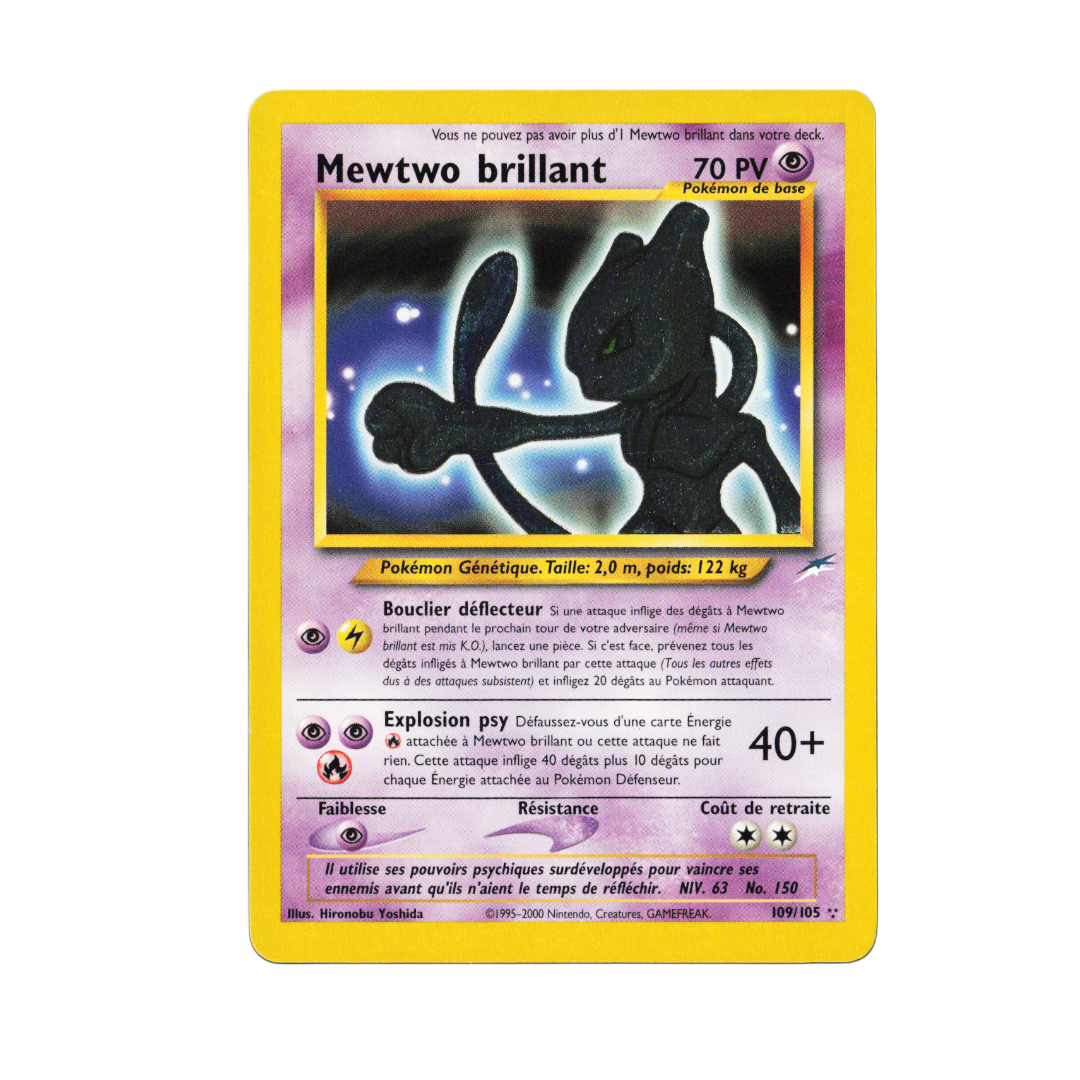
The different types of errors on Pokemon cards
Not all errors are equal, and it is essential to know the precise terminology to navigate this world. The generic term is error card, but this label actually covers several distinct categories, each with its own characteristics and market value.
Misprint (printing error)
The term misprint refers to any error related to the printing process itself. This includes text errors (spelling mistakes, incorrect Pokemon names, wrong attack descriptions), color errors (missing ink, shifted colors), incorrect energy symbols, or wrong card numbers. Text misprints are among the easiest to identify because they are documented and catalogued by the community. For example, certain cards from the French Base Set contain translation errors that were never corrected in subsequent print runs.
Miscut (cutting defect)
A miscut occurs when the cutting machine is not properly aligned with the printed sheet. The result is a card with uneven borders, sometimes revealing part of the adjacent card on the printing sheet. Minor miscuts, where the offset is a few millimeters, are relatively common and have moderate value. However, extreme miscuts, where a significant portion of another card is visible, are exceptionally rare and highly prized. The most spectacular miscuts show two different cards on a single specimen, creating a truly unique piece.
Factory error
This category encompasses errors that occur outside the printing and cutting process. It includes holo bleeds (when the holographic pattern appears on a card that should not be holographic), cards printed with two different fronts and no standard Pokemon back, cards with a missing back or with the back of another card game, cards without ink on one side, or stamp errors where the edition logo is mispositioned, inverted or absent. Factory errors are generally the most visually spectacular and the most valued by collectors.
Content errors
Less visible but equally interesting, content errors concern the card's data itself: incorrect HP, wrong attack cost, missing or incorrect rarity symbol, wrong illustration paired with a Pokemon name. These errors are often corrected in later print runs, which makes the erroneous copies all the rarer and more sought after. To learn how to spot these anomalies and distinguish a real card from a counterfeit, check out our guide on how to recognize a real Pokemon card.
Famous errors from the WOTC era
The Wizards of the Coast era (1999-2003) is considered the golden age of Pokemon error cards, particularly for French editions. Printing processes were less automated and quality controls less rigorous than today, which led to a proportionally higher number of errors. Here are the most emblematic specimens that every error card collector should know about.
Ink and color errors
Among the most visually striking errors are cards with missing ink. Some copies of the French Base Set were released with a layer of ink absent, giving the card a washed-out or ghostly appearance. Others feature color shifts where the different printing layers (cyan, magenta, yellow, black) are not properly aligned, creating a colored blur effect around illustrations and text. These errors are easily identifiable and highly sought after because they affect the card's overall appearance in a spectacular way.
Incorrect energy symbols
Several WOTC-era cards were printed with incorrect energy symbols in the attack cost. For example, an attack that should cost two fire energy displays two water energy instead, or a colorless energy symbol replaces a specific one. These errors are particularly appreciated by collectors because they directly affect the theoretical playability of the card and bear witness to confusion during the layout process.
Holo bleed on non-holo cards
Holo bleed is a phenomenon where the holographic pattern, normally reserved for the illustration window of rare holographic cards, "bleeds" beyond its boundaries and appears on areas that should be matte, or even on cards that are not supposed to be holographic at all. In WOTC French editions, holo bleeds have been documented on common and uncommon cards from the Base Set, Jungle and Fossil. A holo bleed on a common card is a fascinating paradox that immediately catches collectors' attention.
Stamp errors and inverted editions
The edition stamp (the small symbol indicating which expansion a card belongs to) has been a source of numerous errors. Some cards from the Team Rocket expansion were found with an inverted or mispositioned stamp, sometimes even with the stamp from a different expansion. The "Dark" cards from Team Rocket are particularly affected by these anomalies. Cases have also been documented of cards without any edition stamp, making them extremely difficult to catalogue and all the more desirable for specialized collectors.
Text errors in French editions
The French translations of WOTC cards are notoriously famous for their errors. Poorly translated attack names, incomprehensible Pokemon power descriptions, typos in the Pokemon names themselves -- the examples are numerous. Some of these errors were corrected in reprints, making the first erroneous versions rarer. Others were never corrected and have become linguistic curiosities appreciated by French-speaking collectors. To discover more exceptional pieces from the French era, check out our article on the rarest French cards.
How to assess the value of an error card
Determining the price of an error card is a far more complex exercise than for a standard card. There is no official price guide for printing errors, because each piece is by definition unique. However, several factors allow you to estimate the value of an error card with reasonable accuracy.
- The rarity of the error type: A card with completely missing ink on one side is infinitely rarer than a slight miscut of a few millimeters. The more spectacular and unusual the error, the more valuable the card becomes. Major factory errors (double face, missing back) are at the top of the hierarchy.
- The popularity of the Pokemon: An error on a Charizard, Mewtwo or Pikachu will always be worth significantly more than the same error on an unpopular Pokemon. The "desirability" factor of the base Pokemon plays a considerable role in price formation.
- The condition: As with any collectible card, the physical condition of an error card is decisive. An error card in mint condition will be worth much more than the same specimen with signs of wear. Paradoxically, error cards in excellent condition are even rarer than error cards in general, because many were discarded or mistreated by owners who considered them defective. To keep your error cards in the best possible state, follow the principles in our Pokemon card conservation guide.
- Documentation and provenance: An error card accompanied by solid documentation (photos of the booster opening, testimonials, ownership history) inspires more confidence and sells at higher prices. Provenance is all the more important because the market for fake error cards exists and informed buyers demand proof.
- Edition and language: Errors on first print editions and in certain specific languages are more valued. Errors on French WOTC cards enjoy particular appeal among French-speaking collectors, but also among international collectors looking for exotic variants.
Price examples and market trends
To give a concrete idea of the valuations that error cards can reach, here are some documented examples of recent sales and price ranges observed on the market.
The no outline Pikachu (where the outline of the illustration is absent) is one of the most sought-after errors. Copies in good condition have sold for more than 5,000 euros, and certified specimens in high grade regularly reach even higher sums. This error, specific to the earliest print runs, has become an iconic must-have for error card collectors.
Double-face cards (printed with two different fronts and no standard Pokemon back) are among the most spectacular and rarest pieces. These anomalies, resulting from a sheet passing through the press twice with a different orientation, have reached prices exceeding 10,000 euros in private sales and specialized auctions. Their extreme rarity and visually striking nature make them museum-worthy pieces.
Here is an overview of price ranges by error type:
| Error type | Price range |
|---|---|
| Minor miscut (2-3 mm) | 20 - 100 EUR |
| Extreme miscut (adjacent card visible) | 200 - 1,500 EUR |
| Holo bleed on non-holo card | 50 - 500 EUR |
| Text / symbol error | 30 - 300 EUR |
| Missing ink (partial) | 100 - 800 EUR |
| Missing ink (complete) | 500 - 3,000 EUR |
| No outline Pikachu | 3,000 - 8,000+ EUR |
| Double-face card | 5,000 - 15,000+ EUR |
| Stamp / edition error | 100 - 1,000 EUR |
It is important to note that these ranges are indicative and that the error card market is volatile. An exceptional specimen can far exceed estimates, while a minor error on an unpopular card may struggle to find a buyer. The overall trend is nevertheless upward: the error card collecting community expands every year, and historical pieces systematically increase in value.
Grading error cards: PSA, CGC and the specifics
The question of grading error cards is a subject that raises many questions among collectors. The two main certification services, PSA and CGC, have different approaches when it comes to cards with manufacturing defects.
PSA and error cards
PSA (Professional Sports Authenticator) accepts error cards for grading, but with certain nuances. For text errors and recognized variants (such as shadowless cards or first edition errors), PSA assigns a standard grade and mentions the variant on the label. However, for extreme miscuts and major factory errors, PSA may refuse to grade the card or assign an "Authentic" label without a numerical grade, meaning the card is recognized as authentic but not evaluated on the usual 1-to-10 scale. Minor miscuts are generally graded normally, but the off-centering is factored into the final grade and can significantly reduce the score.
CGC and error cards
CGC (Certified Guaranty Company) is generally more welcoming toward error cards. CGC offers a specific label for recognized errors and explicitly mentions the type of error on the certification label. CGC also grades miscuts in more detail, noting the degree of offset on the label. For error card collectors, CGC is often considered the preferred choice because their more descriptive labeling helps document and add value to the error. For a full comparison of both services, see our article PSA vs CGC: which certification to choose.
Should you get an error card graded?
The decision to certify an error card depends on several factors. For high-value errors (above 500 euros), certification is strongly recommended as it provides an essential guarantee of authenticity in a market where fraud exists. Encapsulation also permanently protects the card. However, for minor or low-value errors, certification fees may not be economically justified. In all cases, certification by a recognized service increases potential buyers' confidence and facilitates resale.
Where to find error cards and how to authenticate them
Finding authentic error cards requires patience, method and a good network. Here are the main sources and essential tips for avoiding pitfalls.
Supply sources
- Opening sealed booster packs: The safest method to obtain an authentic error card is to pull it yourself from a sealed booster pack. The probability is obviously very low, but it is the only source that offers indisputable provenance. Film your openings if you come across an anomaly.
- Specialized groups and forums: Online communities entirely dedicated to Pokemon error cards exist. Facebook groups, Reddit forums (r/pokemonmisprints) and specialized Discord servers are places where collectors trade, sell and share their finds. These communities are also excellent resources for authenticating a card before purchase.
- Flea markets and garage sales: Physical sales remain an underestimated source. Many error cards lie dormant in forgotten collections from the 1990s and 2000s. Owners often ignore the nature and value of these errors, which creates opportunities for informed collectors.
- Specialized online auctions: Auction platforms dedicated to collectible cards regularly offer certified error cards or cards with documentation. This is the most reliable source for high-value pieces, as reputable auction houses conduct their own verifications.
Authentication tips
The error card market unfortunately attracts its share of fraudsters. Here are the habits to adopt to protect yourself:
- Be wary of errors that look too perfect: A genuine factory error often presents additional subtle irregularities. A card that appears to have been deliberately modified to simulate an error should raise your suspicions.
- Check consistency with the printing sheet: Authentic miscuts must be consistent with the card layout on the original printing sheet. If the adjacent card visible on a miscut is not a card that actually sat next to it on the sheet, it is a fake.
- Consult the community: Before any significant purchase, submit high-resolution photos of the card to specialized communities. Experienced collectors can often identify a fraud within seconds.
- Prefer certified cards: For high-value pieces, encapsulation by PSA or CGC is the best guarantee of authenticity. Certification fees are a minimal investment compared to the risk of buying a fake for several thousand euros.
- Examine the edges and texture: Authentic Pokemon cards have a specific texture and cardboard composition. A card whose edges appear to have been manually recut or whose surface texture is abnormal is probably a counterfeit. Our guide on how to recognize a real Pokemon card details the essential checkpoints.
Conclusion: a world that rewards knowledge
Pokemon error cards represent one of the most exciting and potentially lucrative niches in the collecting world. They attract a particular type of collector: curious, methodical, patient, and with a sharp eye for detail. Unlike standard collecting where knowing rarity tiers and market prices suffices, the hunt for error cards demands an in-depth understanding of manufacturing processes, familiarity with documented errors, and a solid network within the community.
If this field intrigues you, start by educating yourself: study known errors, join specialized communities, and examine every card that passes through your hands with fresh eyes. You may well discover that a card you have owned for years, tucked away in a corner because it seemed "weird", is actually a rare piece worth several hundred, or even several thousand euros.
At Cards N Packs, we are passionate about every facet of Pokemon collecting, including error cards. Don't hesitate to contact us if you think you own a card with a printing error -- we would be delighted to discuss it with you and help you identify it.
Famous English-language misprints and their market values
While the French market has its own iconic errors, the English-language Pokemon card market boasts some of the most valuable and well-documented misprints in the hobby. English-language error cards dominate auction houses and hold many of the all-time price records, largely because the US and UK collector base is significantly larger and more liquid than any other regional market.
The "No Symbol" Jungle holographic rares
Among the earliest and most iconic English misprints are the Jungle set holographic rares that were printed without the Jungle expansion symbol (a flower). All 16 holo rares from Jungle's initial unlimited print run were affected by this error, including popular cards like Jolteon, Flareon, Vaporeon, Snorlax, and Wigglytuff. The error was corrected in later print runs. A complete set of all 16 No Symbol Jungle holos is a popular collecting goal. Individual PSA 10 copies of the more desirable Pokemon in this set typically sell for a modest premium over their standard counterparts, generally in the range of $100 to $500 USD depending on the Pokemon. These cards are especially popular among WOTC-era collectors in the United States because they represent one of the very first English printing errors to be widely documented.
The "d" Edition Butterfree
One of the quirkiest English-language errors is the "d" Edition Butterfree from the Jungle set. Instead of displaying the standard Jungle set symbol, certain Butterfree cards were printed with a lowercase "d" where the symbol should appear. The exact cause remains debated, but the prevailing theory is that it was a test print character left in the layout files. Graded copies in PSA 10 condition have recently sold in the range of $300 to $600 USD, with PSA 9 copies typically between $75 and $150. While more modest than some WOTC-era errors, the "d" Edition Butterfree remains one of the most recognizable and sought-after quirky misprints from the era.
The "No Stage" Blastoise
The No Stage error Blastoise from the Base Set is missing the "Stage 2" evolution text that should appear above the Pokemon name. This error was present only in early US print runs and was corrected relatively quickly. The card is a sought-after piece for English error collectors. Recent PSA auction data shows graded copies selling in the range of $150 to $600 USD for PSA 7 through PSA 9, with higher grades commanding significantly more. Its desirability is amplified by the fact that Blastoise is one of the original starter Pokemon and a perennial fan favorite.
The "Prerelease Raichu"
Perhaps the most legendary English-language error card is the Prerelease Raichu. The story goes that during a print run of Prerelease Clefable cards, an error occurred which caused approximately 8 to 11 Base Set Raichu cards to receive the "Prerelease" stamp accidentally. For decades, the card's existence was debated -- Wizards of the Coast denied its existence for years until a former employee released an image in 2006. The card achieved almost mythical status in the English-speaking collector community. In 2023, CGC Cards used advanced multi-spectral imaging and XRF scanning to certify Prerelease Raichu cards as genuine for the first time, confirming at least two authentic examples. In late 2025, the only PSA-encapsulated Prerelease Raichu sold for a record-breaking $550,000 at Heritage Auctions, establishing it as one of the most valuable English-language Pokemon cards ever sold. Collectors in the UK and US routinely cite the Prerelease Raichu as the ultimate holy grail of the hobby.
Modern English error cards
The error card market is not limited to vintage. Modern English-language sets continue to produce notable misprints. The Sword & Shield era saw several high-profile errors, including miscut sheets from Evolving Skies that revealed adjacent cards and were selling for $200 to $800 USD on eBay within days of the set's release. The Scarlet & Violet era has produced its own share of errors, including texture misprints on illustration rares where the textured pattern is misaligned or absent. English collectors, particularly in the US, are often the first to document and price these modern errors thanks to the sheer volume of product opened on the American market.
How PSA grades error cards: a closer look for US and UK collectors
For collectors in the United States and United Kingdom, PSA grading is the dominant standard. Understanding exactly how PSA handles error cards is critical if you plan to submit your own finds or purchase graded errors on platforms like eBay.com or PWCC Marketplace.
PSA's tiered approach to errors
PSA categorizes error cards into three tiers for grading purposes. Recognized variant errors, such as the Shadowless print run, the No Symbol errors, or documented text misprints, receive a standard numerical grade from 1 to 10 and are noted on the label as a specific variant. These are the most straightforward to submit because PSA has them in their database and will identify them automatically.
Minor manufacturing defects, such as slight miscuts (where the card is off-center but still within a certain tolerance) or mild holo bleeds, are graded on the standard scale but the defect negatively impacts the centering or surface sub-grade. A card that is 70/30 off-center, for instance, will likely cap at a PSA 7 or 8 regardless of the condition of the rest of the card. This is important to understand because many US and UK collectors focus on PSA 9 and 10 grades for investment purposes, and a minor miscut may actually decrease a card's resale value rather than increase it.
Major factory errors, including extreme miscuts, double-printed cards, blank-back cards, and cards printed on the wrong stock, may receive a "PSA Authentic" designation. This means PSA confirms the card is genuine but declines to assign a numerical grade because the error is too severe to evaluate on the standard scale. While some collectors view the Authentic label as less desirable than a numerical grade, within the error card community it is well understood and does not diminish the card's value. In fact, for extreme errors, the Authentic label is expected and preferred over a forced low numerical grade.
CGC as an alternative for English-market collectors
In the US and UK markets, CGC has gained significant ground among error card collectors specifically because of its more descriptive approach. CGC labels include a written description of the error type, such as "Miscut - Showing Adjacent Card" or "Holo Bleed - Non-Holo Card," which makes the slab self-documenting. For error cards sold online where the buyer may not be able to examine the card in person, this additional context on the label increases buyer confidence and often translates to higher sale prices. Many experienced US collectors now submit their best error finds to CGC rather than PSA for this reason.
Submission tips for US and UK collectors
If you are submitting error cards from the United States or United Kingdom, include a detailed note with your submission explaining the error type. PSA's graders process thousands of cards per day, and a clear description ensures your card is flagged correctly. For CGC submissions, the description you provide often directly influences the wording on the label. Always use PSA's or CGC's declared value tiers carefully -- undervaluing an error card to save on grading fees may result in inadequate insurance coverage during shipping, which is a risk not worth taking with a potentially irreplaceable specimen.
Tips for building an error card collection
Starting an error card collection can feel intimidating, but with the right approach it becomes one of the most rewarding niches in the Pokemon hobby. Here is practical advice specifically tailored to collectors in English-speaking markets.
Where to find error cards in the US and UK
- eBay.com and eBay.co.uk: The largest marketplace for English-language error cards. Use specific search terms like "pokemon miscut," "pokemon error card," "pokemon misprint," or "pokemon holo bleed." Set up saved searches with email alerts so you are notified the moment new listings appear. Many error cards sell within hours of being listed, so speed matters.
- Reddit r/PokemonMisprints: This dedicated subreddit is the single best English-language community for error card collectors. Members post their finds for identification, share sales, and help authenticate questionable pieces. It is an invaluable resource for learning what different error types look like and what they sell for in the current market.
- Facebook groups: Groups like "Pokemon Misprints & Oddities" and "Pokemon Error Cards Buy/Sell/Trade" have thousands of active members. These groups operate as both a marketplace and a knowledge base. Sellers in these groups tend to be knowledgeable collectors themselves, which reduces the risk of purchasing fakes.
- US card shows and conventions: Events like the National Sports Collectors Convention, local Pokemon TCG regionals, and vintage card shows are excellent places to find error cards in person. Dealers who specialize in errors often bring their best inventory to shows, and you can inspect cards firsthand before purchasing.
- UK car boot sales and charity shops: The British equivalent of American garage sales, car boot sales occasionally turn up forgotten collections from the late 1990s and early 2000s. Error cards from this era were often discarded by their original owners who did not recognize their significance.
What to look for as a beginner
If you are just starting out, focus on affordable and identifiable error types. Miscuts are the easiest errors to spot and verify, and minor miscuts from modern sets can be acquired for as little as $10 to $30 USD. Holo bleeds on non-holographic cards are another beginner-friendly category -- they are visually distinctive and difficult to fake. As you develop your eye and your network, you can graduate to more esoteric errors like missing ink, wrong-back cards, and crimped cards.
Keep a reference library of known errors. The PokeBeach forums, the Bulbapedia error card page, and the r/PokemonMisprints subreddit wiki all maintain lists of documented English-language errors with photos. Familiarizing yourself with these resources will help you quickly identify whether a card you encounter is a known variant or a potentially new discovery.
Building value over time
Error card collecting rewards patience. Unlike standard rare cards whose prices are driven by market-wide trends, error cards appreciate based on scarcity and collector awareness. A misprint that sells for $50 today may sell for $200 in three years as more collectors enter the niche and compete for a fixed supply. The key is to buy errors that are visually striking, affect popular Pokemon, and are well-documented as authentic. Cards that meet all three criteria have historically shown the strongest appreciation in the English-speaking market.
Consider getting your best pieces graded early. The cost of PSA or CGC grading for a standard-tier submission is typically $20 to $50 USD, but the value increase from encapsulation and authentication can be many times that amount. Graded error cards sell for a significant premium over raw copies on eBay.com, often 2x to 5x more, because buyers are paying for the certainty that the error is genuine and the card is protected.